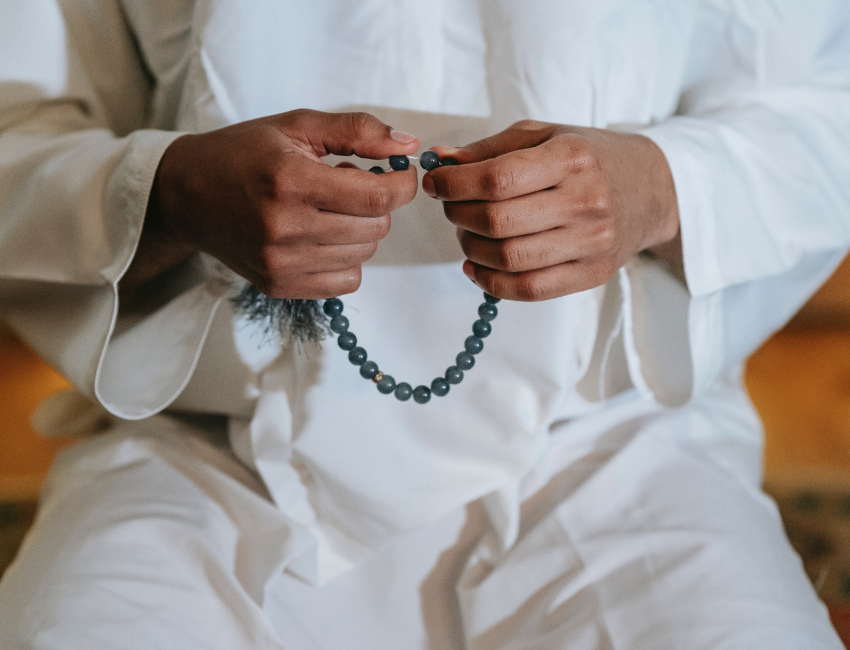
Not only in Islam, but in many other religions prayer beads have played an important role.
In the past the loveliest tespih, as Muslim rosaries are called were made by Istanbul craftsmen and sold to buyers throughout the Islamic world. They were made from gold, silver, ivory, tortoiseshell,
mother-of-pearl, amber, meerschaum, ebony, agalloch wood, and scores of other materials,
some brought from as far afield as Africa, the Far East and South America. Then there are
metals like gold and silver, and organic materials such as elephant ivory, walrus ivory,
whale tooth, tortoiseshell, horn, camel bone, pearls, coral and mother-of-pearl.
There are countless types of wood, including snakewood, ebony, agalloch wood, sandalwood,
bloodwood, olive, rosewood, m’kunguni, tamarind, tulip wood, satinwood, sugar maple, teak,
and Burmese sandalwood. These woods come from many parts of the world, including India,
Egypt, Madagaskar and South America. Another category encompasses seeds and nuts like
coconut, including a variety with a wavy grain called sirçali kuka, olive stones and date
stones.
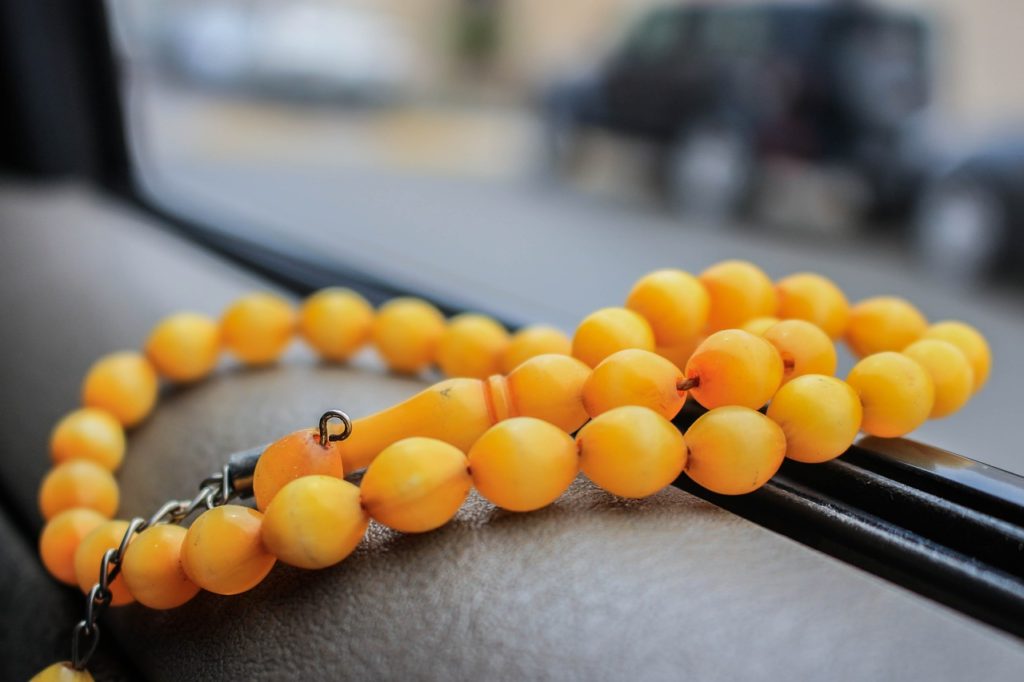
The best tespih makers became famous for their skill at carving the beads. Drilling the holes through them is one of the most difficult parts, the finer the hole, the more skill being required. A late 19th or early 20th century tespih maker named Horozun Salih was one of the most renowned. Tespih beads are made using a small lathe, simple but capable of the extremely fine adjustments required for such tiny objects. These lathes are generally made by the craftsmen themselves. Each piece of the chosen material is first pierced and then cut into the desired shape: spherical, pyriform, oval, flattened spheres, or faceted. For a 99-bead tespih the craftsmen makes 110-120 beads, and then chooses those that match best, saving the remainder for making 33-bead tespihs. Then he makes the other parts: the nisane, a disc which marks each 33 beads, the pul, a tiny bead marking the seventh position, the imame, which is a long piece marking the beginning of the string, and the tepelik at the extremity of the imame. A small socket is gouged in the imame to conceal the knot of the string. All these pieces must also match. Although the best tespih have beads of equal size, some have beads graduated in size, threaded from largest to smallest. In the past they were always strung on silk thread, but today nylon thread dyed to the correct colour is sometimes used instead. Finally the beads may be fitted with bands, engraved with inscriptions, and otherwise decorated, before being strung together, and a tassel attached. Tespih made of fragrant woods are kept in closed boxes to retain the fragrance. In Ottoman times rock crystal beads were preferred in summer for their coolness to the touch, and for the play of light diffracted by the facets. These had silver tassels.Not only Muslims, but Roman Catholics, Orthodox Christians, Jews, Buddhists, and Hindu Brahmanists use prayer beads. Catholic rosaries with 64 beads and a crucifix are part of the clerical garb. Although Islamic prayer beads usually have either 99 or 33 beads, mystic sects sometimes used 500 or 1000 bead tespih with very large beads. Today only a few artizans continue to make handmade tespihs. Most of those sold are made of mass produced synthetic beads of no real value. Antique tespih, on the other hand, were often works of art which took craftsmen months to make.
Ref: Mustafa Çalik/ Skylife